

From Target’s circular red rings to Coke’s iconic cursive namesake, for generations and decades our eyeballs and brains have been trained to associate brand symbols and icons with a brand story. Coke Classic’s logo promises nostalgic refreshment, Target’s rings let you know that they are a reliable shop where you can bullseye in on exactly what you need. You may never notice it happening, but you’ve been trained through consistent messaging and experiences to place value on these symbols and associate them with the brand values that they represent.
When a brand’s identity is cohesive, it increases the brand’s perceived value. Consistency allows your brand to appear more professional, reliable, and trustworthy. When Fiddlehead underwent our own rebrand, we started off our journey wanting to take the right steps toward earning that trust—so that we are immediately recognizable within our industry and with our target audience.
Luckily, we had already done the hard part: building amazing relationships with clients, creating an inclusive culture, and developing an incredible team to deliver our mission. However, as we’ve learned over the past two years’ journey to rebrand our digital marketing agency, building a brand goes far beyond picking a name that reflects your company, it also means establishing and enforcing the brand and the brand values that give your organization meaning.

We’ve undergone this work together as a company and are eager to share our results and learnings! Here is our step-by-step guide to creating brand guidelines, featuring the expertise of our Creative Director, Brittany Weltner and our Director of Client Strategy, Shannon Sweetser, who led the project.
Step 1: Establish the Brand’s Values
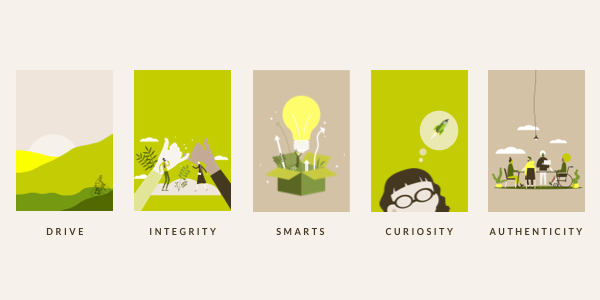
Fiddlehead’s cultural values are shortened to DISCA, and they’re at the heart of how our Fiddleheads treat each other as well as our clients:
DRIVE
INTEGRITY
SMARTS
CURIOSITY
AUTHENTICITY
If you’ve been in business a while, your company has likely developed a set of values. Before you dive into any brand changes or explorations, it’s good to come back to your values and reaffirm your commitment to them. Use your values as a lens for decision-making: does this design help achieve or communicate our company’s overarching mission and values? Why or why not?
Step 2: Establish the Brand’s Personality
For us, it’s important to communicate our Fiddlehead personality through our brand. Who are we with our customers? With each other? How do we operate as a team? Fiddlehead already had a super clear foundation of values, but we wanted the perfect mascot to drive our brand’s voice and we wanted it to make a true splash!
The Fiddlehead name has a playfulness that we love. Communicating our playfulness and curiosity was important to our story and the Dolphin, which ultimately became our mascot, loves to play!

What is your company mascot? How do you trend toward the elements? Is your brand Earth, Wind, Fire or Water...or a combination?
Step 3: Select Your Brand Name

We could have chosen a boring, obvious name to rebrand the company, but we wanted it to symbolize our approach and our strengths—all in one word.
In nature, fiddleheads are the name for an emerging, growing fern. As they mature, they grow leaves and unfurl, revealing their potential as they reach further than before. When we partner with our clients, we create opportunities for growth, giving them the tools to reach their goals. Read more about the name here.
Here are our quick tips for creating your brand name:
Do your research— are other people in your industry/space using the name? A quick Google search will often reveal how difficult it would be to trademark the name for your industry (or any negative connotations with it!).
Keep it simple. Use original spelling if it’s a common word. Pick something that can be made cohesive across all your brand channels.
Think hard before using camel case on your name (i.e. capitalizing the first letter as well as a secondary letter in the middle somewhere, such as SharePoint or FedEx). People will often get it incorrect when typing.
Make your name reflective of your company’s product and culture. You want to conjure your product but also conjure the trust the public already places in your brand.
Unique, memorable names work best. Try to pick something that stands out from the crowd in a positive way.
Try to choose something timeless and future-proof. Don’t tie your name to a moment or a trend. Pick a name that grows as you grow. For example, BookAmazon wouldn’t have worked as well as Amazon, considering where they are now.
Step 4: Use a Design Framework to Guide Decision-Making
The task given to our Creative Director, Brittany Welter, was to simplify the first round of brand assets we had created—while making sure to reflect the brand values we’d already established. Brittany jumped in, using the values as a foundation for every design decision.
To our benefit, Brittany had spent the last few years working on a design framework called The Elements Design Framework, which she used while branding Healthline, Greatist, and Betabrand. She tapped into this Framework to push forward the brand identity for Fiddlehead and the results are spot-on.
The Elements Design Framework helps creatives and companies use a repeatable framework for designing just about anything. This was built out of a frustration with "subjective" creative; too many times, Brittany found clients would get too hung up on their personal likes and dislikes while working to determine a direction for their brand. Subjective branding is problematic because the key players would sit in a room, ideate, and then create a brand based on personal design preferences and “what feels good” rather than having the brand evolve around the vision, mission, and values.
Brands need to stand for something and to be rooted in the company’s core values. That’s why the Elements Design Framework empowers decision-makers by simplifying the quest to understand what drives the brand’s identity. Branding can be "objective" if you break the design into the most basic elements of all—earth, wind, fire, and water. The framework pairs the behavior of how the elements move with how the company and its people move: fire moves rapidly, air moves spontaneously, water moves fluidly, and earth moves constantly.
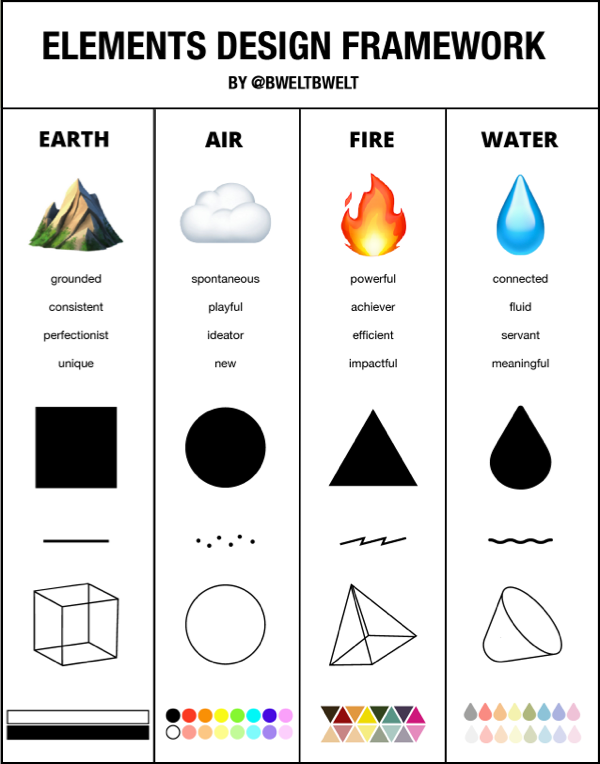
Once someone sees themselves, their product, or their company as one of those elements, it's a common, shared visionary foundation to design from.
Step 5: Design Attributes for Your Brand
Brands are distilled to the most basic design attributes: shapes, lines, and color. When we started rebranding Fiddlehead, the first thing we did was take Fiddlehead’s core values and place them within the “Element’s Design Framework'' to determine the brand element’s breakdown. Every design decision was determined by the chart that starts with Fiddlehead’s values which Brittany then matched to each element’s values. We also pulled values from the company’s personality mascot, the Dolphin, which is a combination of air and water.
DRIVE [Fire]
INTEGRITY [ Earth]
SMARTS [Fire]
CURIOSITY [Air]
AUTHENTICITY [Ground]
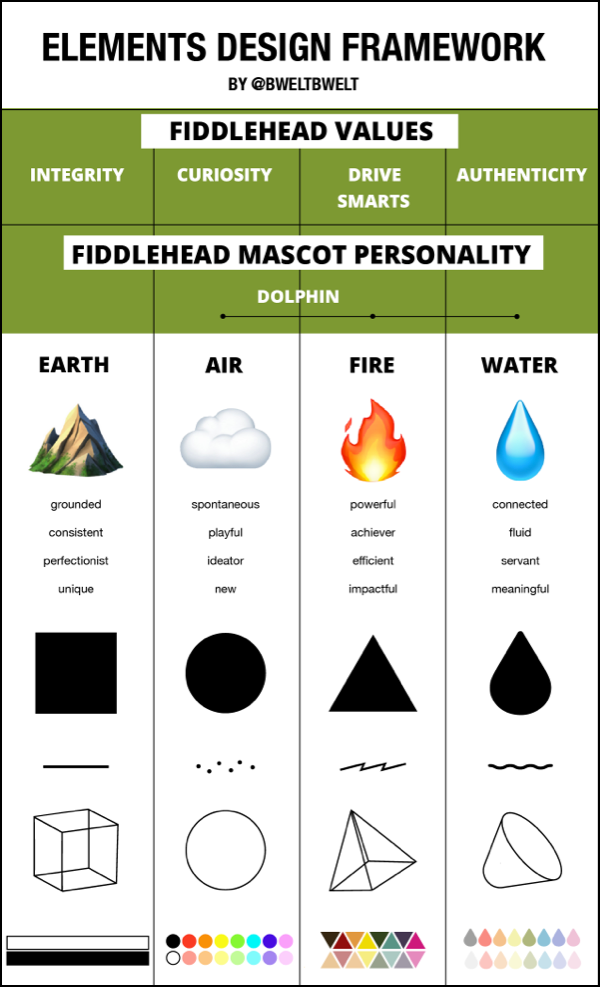
Each element has its own natural shape, line and colors. Fiddlehead had the most “fire” values, so Brittany chose the fire color palette, which are rich shades of greens and browns. The shapes were a mix of the elements (circle = air, pill shape=air+water and rectangle=ground.) She determined the shapes by striking a balance between our playfulness and curiosity (dolphin personality) and the seriousness of our work (data!) and our brand personality of being grounded in data and consistent with results for our clients.
Our illustrations have smooth, rounded edges (similar to the curves and organic shapes you see in our logo) which makes for an approachable brand. As an agency, we want to be approachable but serious, which is achieved with our photography. The photos are playful (air), inclusive (water) and perfect (ground) thanks to the amount of white space surrounding the images.
This framework creates a more objective, creative framework that all key players can refer to for design choices.
Color
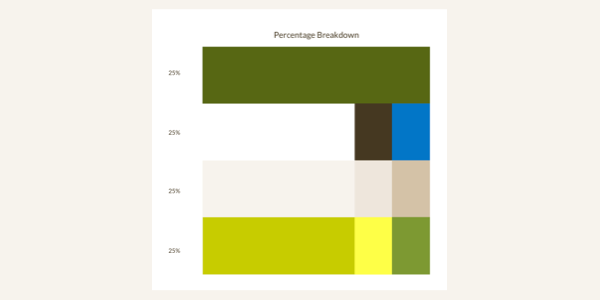
“Fiddlehead” green is our main color because it is obviously the main color you see in natural fiddleheads. The palette is overall a “fire” palette which contains deep and rich jewel tone colors. We added brighter colors (Sunshine Yellow and Ocean Blue) for a little pop.
Logo

We love how the Fiddlehead shape sends out growth and power spiral energy—true to shapes we see in nature. To get us started with our logo’s mark, we had another designer work on several concepts which featured the fiddlehead spiral. As you can see in the V1 version of the logo, we were playing with the concept of two distinct opposing spirals, but by the time we reached V2 we felt that the single fiddlehead fern was the way to go.
While V2 of the logo was a beautiful jumping off point, we felt that the V2 version of the logo was still too complicated. They say “simplicity is the ultimate sophistication”; it was ultimately the simplest version (V3) that we chose to be our iconic mark.
A logo should be identifiable at a small scale (favicon) up to a large scale (billboard), so we consolidated some of the leaves and really utilized the space that resulted from removing the extra leaves. The spiral is now more distinct and the icon reads much more clearly at any size. We can’t wait to get some swag and wear our logo with pride!
Step 6: Check the Accessibility of Your Design
The intention for UI design is to maximize usability for everyone. We brought on Debbie Levitt, a User Experience Strategist and founder of DeltaCX, to verify that our color palette was in line with accessibility standards. Surprisingly, a lot of websites don’t have high enough color contrast (think dark grey on light grey), meaning that people who are color blind or farsighted might not be able to read your content. Color contrast is just one example of many accessibility standards.
The groundwork we laid for accessibility proved useful when we rolled out the second part of the brand guide: Data Visualization.
STEP 7: CREATE DATA VISUALIZATION GUIDELINES
Our CEO Melinda’s enthusiasm for beautiful charts and graphs was evident when she ordered Show Me the Numbers: Designing Tables and Graphs to Enlighten by Stephen Few to help guide our team toward creating data visualization guidelines. The book outlines the standards for visualizing data in ways that communicate the data, tell a story, and leave out the rest.
We created an extensive 23-page internal guide that highlights the “Do’s and Don’ts” for data visualization for our company. These brand guidelines are put in play often, showing up in client dashboards, presentations, and internal reports. If you feel like nerding out with us on data visualization, give the book a read; it’s a great coffee table book!
STEP 8: DEFINE GUIDELINES FOR PHOTOGRAPHY, COLLAGE, AND ILLUSTRATION
Once you have the basics, the illustration and photo collage styles add cohesion and personality. When choosing photos and illustrations, keep these things in mind:
The images should always tell a story on their own (yes, without words!)
The images should reflect the values and company culture.
Pro tip: think like a graphic designer and apply the 80/20 is a great rule. (80% image: 20% white space and vice versa. This rule makes your brand look elevated vs. cluttered.
PHOTOS

A lot of companies have budget (or time) limitations for creative work. Concepting for photoshoots, as well as booking space and talent, are all extremely time-consuming (and expensive), so having a guide is a savior for your team. The guide allows you to find unique stock images and edit them to fit your brand. Here are a few tips for finding better stock photography:
There are a lot of free stock photography sites out there, but our favorites are those that specialize in diverse and inclusive photography. We like free sites like Nappy, a stock photography site that specializes in “beautiful, high-res photos of black and brown people” and All Go, a free collection of stock photos of plus-sized bodies doing normal activities. Of course, you can’t go wrong with an additional subscription to a few high-quality sites. We like Stocksy, Shutterstock, and Getty Images.
If you have photographer friends, ask them to use their work and credit them! The more authentic, the better. Who knows? Maybe they will give you a deal on a shoot within budget.
When searching for photos, type in your target demographic and adjectives like “silly, quirky, etc” to get a more specific personality for your model.
Photoshop backgrounds and apparel to match your brand colors.
Find a unique perspective or angle for the shot (what is the story behind your photo?)
Avoid busy backgrounds because they make it more difficult to edit.
Keep your stock photos organized in a library on a Google Drive for future use.
Illustration

Illustration is another great visual tool that allows the designer to maintain a unique brand aesthetic by editing the illustrations to fit brand shapes, colors, etc.
The Fiddlehead vision is “We drive growth for clients we love, by providing honest, data-driven digital marketing.”
Instead of a photo, we chose an illustration to reflect our company vision because it’s inviting, less literal, and leaves a little more room for interpretation for the viewer. For example, one person might imagine this tropical jungle to be their business growing overseas, while another client might see the path as how Fiddlehead holds their hand for the journey.
FINAL THOUGHTS: IN PRAISE OF BRAND GUIDES
Brand guides are indispensable tools that will save your company a lot of time and money in the long run. The beauty of a brand guide is that once you have it, you can pass it along to any creative (in-house, agency, or freelancer) and they will be more efficient in creating creative assets and communicating your brand through any given medium.
With a brand guide, you will be able to create email campaigns, ad campaigns, website pages, and social content seamlessly. You won’t ever have to start from scratch because you have a perfectly curated reflection of your core values. However, remember, brands are always evolving. Your guide should be a living, breathing, working example of your brand vision and how it should be used in practice.
Is your company ready for any of the below creative work?
Company Branding
Social Media Content Strategy
Social Media Content Creation

ABOUT OUR CREATIVE DIRECTOR
Brittany Weltner is a Creative Director who has worked in SF in the Advertising, Tech & Fashion Industries for the last decade. She has led brand design and social media for Gap, Charles Schwab, Netsuite, Betabrand, Healthline, among many startups. Let us know if you want to create something for your brand. You can also check out her work here.

ABOUT OUR DIRECTOR OF CLIENT STRATEGY
Shannon Sweetser is a creative marketing leader and experienced digital marketing strategist with a passion for telling meaningful stories that build brands and ignite passion for products, tech and communities. An alumni of Google, Jawbone, Hubspot, she currently works at Fiddlehead as Director of Client Strategy for key clients Impossible Foods, Dropbox, Netflix, and LaunchDarkly. Learn more about her here.